

Microphone Polar Patterns Explained: Choosing the Right Pattern for the Right Application
Choosing a microphone isn't only about sound quality, frequency response, or whether it's wired or wireless. One of the most important—and sometimes overlooked—specifications is the polar pattern.
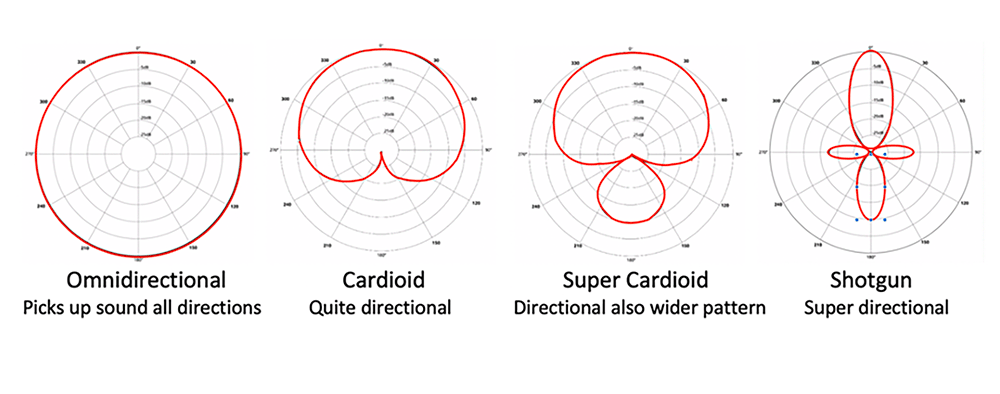
A microphone's polar pattern describes where the microphone picks up sound and where it rejects it. Some microphones capture sound almost equally from every direction. Others concentrate primarily on what's directly in front of them.
Neither approach is automatically better. The right polar pattern depends on the environment, the sound source, how much the performer moves, and how much unwanted sound you need to keep out of the microphone.
Airwave Technologies offers microphones using omnidirectional, cardioid, supercardioid, and hypercardioid pickup patterns, giving users different tools for everything from presenters and theater performers to fitness instructors, vocalists, choirs, and musicians.
Omnidirectional: Natural Sound and Freedom of Movement
An omnidirectional microphone is designed to pick up sound from all directions around the microphone capsule. Unlike a directional microphone, there isn't one sharply defined area the user must remain directly in front of.
That makes an omni especially forgiving.
For a headset microphone, this is a significant advantage. The person wearing the microphone can turn their head, look down, move naturally, or slightly change the position of the boom without causing dramatic changes in level or tone.
Omnidirectional microphones also tend to produce a very natural, open sound and do not exhibit the proximity effect associated with directional microphones.
What Makes an Omnidirectional Pattern Desirable?
The biggest advantage is consistency.
When a microphone is worn only an inch or two from the mouth, the capsule doesn't necessarily need a tightly focused pickup area. Because the microphone remains close to the source, an omnidirectional design can provide excellent vocal clarity while allowing the wearer to move naturally.
Omni headset microphones are particularly useful when:
- Natural vocal reproduction is important
- The performer or presenter moves frequently
- The microphone needs to remain visually discreet
- Consistent pickup is more important than maximum isolation
- The microphone is being used for speech, theater, worship, presentations, or performance
The tradeoff is that an omni microphone also picks up more surrounding sound than a directional microphone. In extremely loud environments or situations where feedback is a major concern, a directional pattern may be preferable.
Airwave Omnidirectional Headset Microphones
Most of the Airwave Technologies headset lineup uses omnidirectional capsules, but each model is designed for a somewhat different user or application.
HSD-SLIMLINE+SE — Best All-Around Choice for Speech and Presentations
The HSD-SLIMLINE+SE is an ultra-lightweight single-ear headset using a European-made omnidirectional capsule. Airwave positions it for speech and vocal applications, making it a strong general-purpose choice for houses of worship, schools, presentations, lectures, and other situations where clear hands-free speech is needed.
Best for:
Presenters, pastors, educators, speakers, worship leaders, and general-purpose headset applications.
For someone who wants a lightweight, discreet headset without moving into the higher-priced premium models, the HSD-SLIMLINE+SE is the logical starting point.
HSD-SLIMCLIP SYSTEM — Best for More Active Presenters
The HSD-SLIMCLIP SYSTEM uses the same omnidirectional approach but adds a dual-ear attachment that helps keep the microphone securely positioned. The system can also be converted back to single-ear use by removing the Slim Clip attachment.
Best for:
Animated speakers, worship leaders, educators, stage presenters, or anyone who wants more headset stability without giving up the natural sound and forgiving pickup of an omni microphone.
HSD-TITANIUM — Best for Premium Speech and Vocal Reproduction
The HSD-TITANIUM steps up to a premium European-made omnidirectional capsule designed for excellent clarity and higher-quality sound reproduction.
Best for:
Professional presenters, pastors, vocalists, corporate events, broadcast-style applications, and users for whom vocal detail and overall sound quality are especially important.
For installations where a headset microphone will be used frequently and sound quality is a priority, the TITANIUM is a natural step above the SLIMLINE+.
HSD-TITANIUM SLIM CLIP SYSTEM — Premium Sound with Added Stability
The HSD-TITANIUM SLIM CLIP SYSTEM combines the premium omnidirectional TITANIUM microphone with Airwave's dual-ear Slim Clip system.
Best for:
Professional presenters and performers who need premium vocal reproduction but also move enough that a more secure dual-ear headset is desirable.
Think of it as the TITANIUM for someone who doesn't stand still.
HSD-DIAMOND — Best for High-End Professional Applications
The HSD-DIAMOND is Airwave's pro-level single-ear headset, combining an omnidirectional pickup pattern with a premium capsule and lightweight stainless-steel construction. Airwave specifically identifies television, theater, stage, lecture halls, houses of worship, and other applications requiring minimum visibility and hands-free operation as appropriate uses.
Best for:
Theater, professional stage productions, broadcast, high-end houses of worship, and applications where both audio quality and appearance are critical.
HSD-DIAMOND SLIM CLIP SYSTEM — Best for Professional Performance with Maximum Stability
The HSD-DIAMOND SLIM CLIP SYSTEM takes the premium omnidirectional DIAMOND capsule and adds dual-ear stability through the Slim Clip system.
Best for:
Professional performers, theater productions, energetic presenters, and other situations where premium sound quality and a secure headset fit are equally important.
HSD-MICRO — Best When Discretion Matters Most
The HSD-MICRO takes a somewhat different approach. Its omnidirectional capsule is paired with an extremely discreet short-boom single-ear design.
The microphone is intended for performers, presenters, worship leaders, theater productions, live performance, corporate presentations, and broadcast applications where visibility needs to be kept to a minimum. Its omnidirectional capsule provides natural voice reproduction while helping reduce plosives, wind noise, and excessive low-frequency buildup.
Best for:
Theater, broadcast, stage productions, corporate presentations, and any application where the microphone should almost disappear on the wearer.
Cardioid: More Focus, Less Background Sound
A cardioid microphone gets its name from its roughly heart-shaped pickup pattern.
It is most sensitive to sound arriving from the front while rejecting much of the sound arriving from behind. This allows the microphone to concentrate more heavily on the desired source while reducing ambient sound and helping improve gain before feedback.
What Makes Cardioid Desirable?
Cardioid microphones are useful when the surrounding environment is loud.
Instead of capturing everything around the microphone, the pattern focuses on the person or source directly in front of the capsule.
That makes cardioid especially valuable for:
- Loud stages
- Fitness instruction
- Live vocals
- Presentations in noisy spaces
- Applications with nearby loudspeakers
- Situations where feedback rejection is important
The tradeoff is that microphone positioning becomes more important. If the user moves too far away from the front pickup area, the voice can become quieter or change in tone.
HSD-FITNESS — The Airwave Cardioid Headset
The HSD-FITNESS is the key cardioid model in the Airwave headset lineup.
That choice of polar pattern makes sense for its intended environment.
Fitness instructors often work in rooms with loud music, reflective surfaces, PA speakers, and considerable ambient noise. The HSD-FITNESS uses a cardioid pattern to focus more heavily on the instructor's voice while reducing background sound and improving resistance to feedback.
Its adjustable gooseneck boom helps maintain proper microphone positioning, while its dual-ear design keeps the headset secure during movement. The microphone is also sweat resistant and rated to handle vocal levels up to 140 dB SPL.
Best for:
Fitness instructors, group exercise leaders, trainers, coaches, and other high-energy environments.
For these applications, the cardioid pattern isn't simply a specification—it's one of the reasons the microphone works so well for the job.
Other Airwave Cardioid Microphones
The same principle applies elsewhere in the Airwave lineup.
The AT-41 handheld vocal microphone uses a cardioid pattern, making it well suited for live vocals where rejecting surrounding stage sound is important.
The AT-GOOSENECK also uses a cardioid condenser capsule, helping keep attention on the speaker at podiums, lecterns, conference spaces, and similar installations.
The AT-CEILING CHOIR-C uses a cardioid pattern to provide directional pickup for choirs and ensemble applications, while the AT-CHOIR system includes an interchangeable cardioid capsule as one of its available pickup options.
Supercardioid: Tighter Focus for Instruments
A supercardioid microphone takes the directional characteristics of a cardioid and tightens the pickup area even further.
Compared with cardioid, it provides greater rejection from the sides and can offer better isolation from nearby instruments and ambient noise. The tradeoff is a small area of sensitivity directly behind the microphone, so positioning becomes more important.
What Makes Supercardioid Desirable?
Supercardioid works particularly well when you want to isolate one specific sound source.
This makes it ideal for:
- Individual instruments
- Loud stages
- Closely spaced musicians
- Situations where neighboring instruments could bleed into the microphone
- Applications requiring precise microphone placement
Airwave does not currently use a supercardioid capsule in its headset line. Instead, the pattern is used extensively in the AT-INSTRUMENT Series.
Airwave Supercardioid Microphones
The following AT-INSTRUMENT models use supercardioid condenser capsules:
AT-INSTRUMENT / GUITAR — designed to mount directly to a guitar while rejecting more surrounding stage sound.
AT-INSTRUMENT / CELLO — provides focused pickup of the instrument while helping isolate it from neighboring instruments and stage noise.
AT-INSTRUMENT / VIOLIN — uses a precisely positioned supercardioid capsule to capture the instrument while minimizing unwanted background sound.
AT-INSTRUMENT / TRUMPET — provides focused pickup for a powerful brass instruments that often perform in loud ensembles or stage environments.
AT-INSTRUMENT / PIANO-S — uses two supercardioid microphones to capture a piano in stereo while helping control surrounding stage noise.
For these applications, the tighter pickup pattern allows the microphone to concentrate more heavily on the instrument immediately in front of it rather than the entire stage.
Hypercardioid: Maximum Focus and Isolation
A hypercardioid microphone takes directionality another step further.
Its front pickup area is narrower than both cardioid and supercardioid, providing very strong rejection of sound arriving from the sides. That makes hypercardioid particularly useful when isolation is critical.
However, hypercardioid microphones also have a more noticeable rear pickup lobe, so speaker and microphone placement must be considered carefully. They also require more precise aiming toward the desired sound source.
What Makes Hypercardioid Desirable?
Hypercardioid is especially useful when the microphone needs to concentrate on one sound while rejecting as much surrounding noise as possible.
Typical applications include:
- Film and video production
- Theater
- Shotgun microphone applications
- Choirs in challenging acoustic environments
- Loud stages
- Situations requiring significant off-axis rejection
Airwave does not currently use hypercardioid capsules in its headset microphones.
Instead, the pattern appears in products where extremely focused pickup is desirable.
Airwave and Acacia Hypercardioid Microphones
The AT-CHOIR includes an interchangeable hypercardioid capsule, allowing an installer or sound engineer to choose a tighter pickup area when greater isolation is needed. The same system can also use omnidirectional or cardioid capsules, making the AT-CHOIR particularly flexible for different rooms and applications.
Airwave also carries the Acacia Audio LIZ-SHOTGUN series, including the LIZ-SHOTGUN, LIZ-SHOTGUN M, LIZ-SHOTGUN S and related microphone kits, which use hypercardioid designs for highly directional audio capture.
Which Polar Pattern Is Right for You?
There isn't one polar pattern that's best for every microphone.
The goal is to match the pattern to the environment.
If you're a pastor, presenter, actor, worship leader, or speaker, an omnidirectional Airwave headset such as the HSD-SLIMLINE+SE, HSD-TITANIUM, HSD-DIAMOND, or HSD-MICRO provides natural sound and allows more freedom of movement.
If you move frequently and want additional security, the HSD-SLIMCLIP, HSD-TITANIUM SLIM CLIP, or HSD-DIAMOND SLIM CLIP SYSTEM adds dual-ear stability while retaining omnidirectional pickup.
If you're a fitness instructor or trainer working around loud music and room noise, the cardioid HSD-FITNESS is the clear choice because its directional pattern is specifically designed to focus on the instructor and reduce unwanted surrounding sound.
If you're miking an individual instrument on a busy stage, the supercardioid AT-INSTRUMENT Series provides greater isolation.
And when maximum directionality is needed for choir, theater, video, or production work, a hypercardioid solution can provide even greater control over what reaches the microphone.
The Pattern Is Part of the Performance
A microphone can only reproduce the sound it captures.
Choosing the correct polar pattern helps determine what gets captured in the first place.
Sometimes that means choosing an omnidirectional headset that lets a performer move naturally. Sometimes it means using a cardioid microphone to reduce a noisy room. Other times it means narrowing the pickup even further with supercardioid or hypercardioid microphones to isolate a specific instrument or sound source.
Understanding those differences makes it easier to choose the right microphone—not simply based on specifications, but based on how and where it will actually be used.
That's why Airwave Technologies offers microphones with multiple polar patterns: the right microphone starts with choosing the right way to listen.
